
Remember, the new blog is at https://hughsk.vivaldi.net All the fine is now there!
He is not here…
… He has risen.
Well, the blog has, in this instance. I’m forsaking ad-laden WordPress.
If I continue to dribble verbage, it will be at the Vivaldi-powered One Foot in the Cloister. It’s pretty basic, but it’s free of cost and ads. Monk friendly, in other words.
Try Vivaldi as your new browser (and more) while you’re at it. It’s free, Scandinavian and privacy focused, and does not mine and sell your data like Google and Facebook, et al.

Pax.
I’m not the only one.
It seems David Mitchell agrees with me about the tabloidisation of the BBC.
Vocations before the Council—A Snapshot
Not all was utopian in the Church before Vatican II, even if since the Council she has grown increasingly dystopian. The danger we face today is to fall into the post hoc ergo propter hoc fallacy. Not everything that came after the Council can be simplistically explained away as a direct result of the Council, be that thing good or bad. The Council occurred at a particular point of time in history and culture, and the implementation of its decrees was a distinct phenomenon, which acted almost as a corrective to the deficiencies of the conciliar texts in the eyes of their implementers, and certainly as an interpretation of those texts according to an agenda that was not easily reconciled to the express will of the majority of the Council Fathers.
Should we have had a Council in the 1960s, of all decades? Well, as we shall soon discover with Covid, hindsight is a wonderful thing.
In 1956, two issues of the New York monthly, The Catholic Mind, ran pieces on issues confronting apostolic sisters’ congregations at the time. In the April edition, Sr Mary Emil IHM, of the only-recently-defunct Marygrove College in Detroit (from which a cornucopia of books have since been digitized and added to the Internet Archive), addressed in her article, among other things, “The Vocation Crisis:” Continue reading “Vocations before the Council—A Snapshot”
Holy Smoke! The Crisis we Face
BEFORE READING WHAT follows you would do well to listen first to that to which I am responding, namely Damian Thompson’s Spectator podcast, Holy Smoke. You can find it through your podcast apps or go to the online version here. It is about 38 minutes in length. He is joined by the ex-Anglican cleric Gavin Ashenden, and they reflect on both the Catholic Church and Anglican and other Protestant denominations. A number of interesting points are raised about the crisis in the Church precipitated by Covid. It is provocative, and not just of thoughts, and it merits an attentive hearing.

That word crisis figures early on in the podcast. In general English usage it tends to mean a moment of heightened tension or instability, the climax of a dramatic episode, a turning point. Ashenden rightly points out that the Greek word from which we take our word, κρίσις, has additional, and perhaps primary, meaning in Greek: not just a turning point, but a moment of judgment and decision. So coronamania represents a moment of crisis for the Church in that it represents a turning point, a moment when judgments must be made, and also the active decisions that flow from those judgments. Thompson’s opening declaration that this moment of crisis and the response of the bishops to it made him feel that “it’s all over” is a useful reminder that there is something apocalyptic about this crisis, again in the sense of the Greek origin of that word, ἀποκάλυψις, an uncovering or revelation. For Thompson their response to the Covid crisis reveals something about the bishops, both Catholic and Anglican. In fact, it reveals something about contemporary Christianity in general. Continue reading “Holy Smoke! The Crisis we Face”
In Thanks for a Classic
“THE LORD GAVE, and the Lord has taken away; blessed be the name of the Lord.” (Job 1:21) The experience of the previous few days has felt more in the line of the taking away, but today has been one of the giving. Today I discovered that friends (who will remain unnamed here to prevent blushes but who live within the realms of Her Majesty but not exactly in Britain, or in a dominion), have bestowed on me the unmerited kindness of a full five-volume set of the newly republished classic by (Blessed) Ildefonso Schuster OSB, The Sacramentary. The godliest kindness, and also blessing, is that which is unmerited.
It has been recently re-released, with an introudction by Gregory Di Pippo, by Arouca Press, the small Canadian Catholic publisher with a most arresting catalogue of works both old new. It is available in both soft- and hard-cover editions, and the price is remarkably modest. I will be speaking from the hardcover edition.

What makes this classic worthwhile today? Continue reading “In Thanks for a Classic”
Shameless Self-Advertising
TODAY IS THE OFFICIAL PUBLICATION date of A Limerickal Commentary on the Second Vatican Council, a recent little labour of love of mine. It publishes for the first time a typescript set of limericks written by anglophone bishops during the Council.
Apart from being very witty, they offer an insight into how some celebrities and issues were being received among at least some of the bishops at the Council. They are a sort of para-commentary to be read alongside the formal, academic commentaries. They remind us that the Council Fathers were men with their own thoughts and insights, and not an ideologically-uniform body. It humanizes the Council just a little. Continue reading “Shameless Self-Advertising”
The Downside Decision—A Hasty Reflection
ON WEDNESDAY THE COMMUNITY at Downside Abbey, the oldest community in the English Benedictine Congregation (the EBC itself the second-oldest congregation in the Benedictine order), elected Dom Nicholas Wetz as the next Abbot of Downside. Dom Nicholas is a monk of Belmont Abbey and has been serving as prior administrator at Downside in recent years. The previous abbot’s departure was unhappy, and the burdens of the school—its expense, its governance and ongoing demands of safeguarding—have taken a further toll on the brethren at Downside. Separating the school from the community has been a complicated task.
Today the community at Downside announced that it has decided to move from its impressive home in the west country. Its new home is yet to be decided. There will be many factors to be taken into account in reaching a choice of new home. In the few hours since the announcement the reaction has principally been one of dismay. Downside is effectively synonymous with its glorious abbey church, with its soaring neo-gothic nave, exquisite side chapels, and a sacristy that is truly remarkable. With Dom Oswald Sumner it became noted in the twentieth century for its vestment making and most EBC houses will have sets from Downside, Douai included. Their design was very much in the monastic stream of the liturgical movement: conicals, semi-conicals, semi-gothics, in fine silks and adorned with elegant orphreys.
It is a community with a strong scholarly tradition, again very much in the monastic way of things. Downside was the heart of the movement a century ago to bring a more monastic ethos into the EBC, beginning with itself. It was not wholly successful and there were casualties, many of which were fruitful in their own way, as with Dom David Knowles. The community had provided its monks as the first leaders of the Church in Australia, in the persons of the young vicar apostolic Bernard Ullathorne, succeeded by archbishops Bede Polding and Bede Vaughan. Dom Gregory Murray was perhaps the pre-eminent monastic musician in his day. Dom Hubert van Zeller was a popular spiritual writer, a talented sculptor and his caricatures of monastic life under the nom-de-plume Brother Choleric remain a delight. Its school has long been at the heart of the English Catholic establishment.
I could go on.

It is undoubtedly heartbreaking news. Yet is it all gloom and doom?
In electing an abbot, indeed a monk of another community, as their abbot after a period of administratorship, the Downside brethren have decided to resume fuller responsibility for their destiny. An extended term of administratorship, and an extension of all the congregational structures of support, would have been little better than lying at anchor near the shore. The inevitable decision either to return to the difficult terrain of the shoreline, or to put out into deeper water (cf Luke 5:4), would have been evaded. Prevarication can only endure so long.
In deciding now to move, the Downside community has chosen to put out into deeper water. We must pray their catch be great.
It is heartbreaking that they will leave their historic, and beautiful, home. Yet, a monastic community is far more than its buildings. Its buildings are very important, of course, and a monastic stability ensures that a community feels wedded to its place. However, all the ancient houses of the EBC have moved before, sometimes for a positive reason, sometimes compelled by circumstances. Douai’s return to England in 1903 was not a free choice. If not for the French government’s association laws perhaps we might still be in Douai, near Lille, with our lovely Pugin church and an un-despoiled library. But we are not, and in fact we flourished for decades on our return to England. We made the best of our emergency accommodation, and indeed we are still living in it. It was the second time we had been forced from our home; the French Revolution forced us from our small but significant monastery in Paris, in the church of which lay the exiled James II’s tomb. In many ways Paris was the site of my community’s glory days. But time and circumstance move on, and monastic communities must adapt as necessary, or die. Who knows but Douai may yet move again one day.
While its buildings are a glory of the Downside community, they are also a burden to it. They must be maintained, at great expense. The burden of popular esteem and attachment, as well as their own sense of being at home in them, weigh heavily on the community without doubt, and such a weight limits a community’s freedom of decision, both practically and psychologically. In setting aside this burden, beautiful and historic though it is, the Downside community has decided to make itself freer to make the necessary choices for its future. Monastic life has to be guided by more than the need to be curator of historic buildings.
There is a parallel in the tradition of EBC schools. All the EBC monks’ houses had schools; it’s what we did, along with working on the mission in England and, later, beyond. Yet the world has changed so much, as has education, that running a school now is not something that a monastic community can easily do any more. The burdens of modern administration and financing, maintenance of plant and appointment of staff—quite apart from the modern recognition of the need for enhanced safeguarding—are beyond the capacity of monastic communities. If we are brutally honest, tradition notwithstanding, running a school in the modern sense is not easily accommodated to the Rule of St Benedict. But more prosaically, running a school is now beyond the practical capacity of the modern EBC houses. Some of us closed our schools long ago, and have in many ways prospered because of the decision to do so.
When a monastic community feels it must staff and maintain a school, especially one of historic esteem, then its monastic vocation is to that extent constricted. St Benedict did not envisage a community of school masters; nor, indeed, of parish priests. It is almost certain that the monks of the EBC will have to face up to these historic inheritances and determine whether they give life still to their communities, or whether they have become burdens too great, too distracting, too constricting to bear fruitfully. They are happy burdens while they can be easily borne, but when they cannot the brethren surely must take priority over their buildings, their schools, their history, their traditions and their public profile.
Sad as it is, I cannot help but wonder if this is the first of many hard decisions to be made in the EBC over the next few years. In 20 years, there will be no monks in schools, and maybe there will be none in parishes either. Without schools or parishes, the monasteries of EBC monks will either scramble to find another “mission,” or they will embrace the mission already given them in the Rule of St Benedict—to establish a school of the Lord’s service, to live by the work of their hands and to sanctify each day with the worship of God in the Opus Dei, to welcome the pilgrim and offer a spiritual oasis in the desert of secularism, and above all, to prefer nothing to Christ (RB 72)…nothing whatsoever.
It’s a tough call.
“That would be an ecumenical matter”—Dom Gregory Murray and Plainsong: an Exchange
Dom Gregory Murray (1905-1992) of Downside Abbey was one of the great monastic musicians of the twentieth century. His organ works are held in especial regard, though he was no slouch on the chant. On the other hand, he prepared so comprehensively for the introduction of the vernacular in to the liturgy that he had everything ready for Downside to embrace from the outset a wholly English office. Years ago I heard a monk describe Murray as having been the rudest man in the English congregation. I cannot make a judgment on that claim.
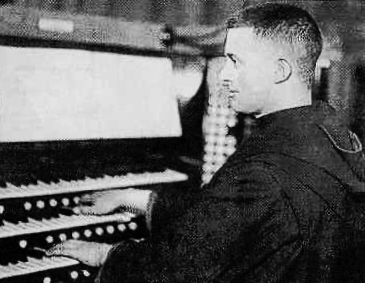
Nevertheless in an exchange of letters in The Tablet in 1937 we can see that as a precocious young monk he was prepared neither to don velvet gloves nor to sugar his speech. Continue reading ““That would be an ecumenical matter”—Dom Gregory Murray and Plainsong: an Exchange”
Covid-19: A Crisis for the Church
WHILE NOT DARING to speak for prelates, I feel fairly confident in saying that the Covid-19 pandemic caught most parochial clergy off-guard, and monasteries too. Witness the mad scramble to make provision for a congregation not merely forbidden from attending Mass, but from even entering their churches. (This raises the question of the purpose of our church buildings and to whom, at least morally, they belong, and to what degree we are accountable to God for their use; but that is not for now.)
The move to restrict the liturgy was no doubt a justifiable one. But the move to shut the churches completely came not from the government but from at least some of our own bishops has left many people disturbed. The government had been prepared to exempt churches but it was the bishops’ conference that approached the government asking for churches to be closed. It remains to be shown how an empty church with no more than a handful of people in private prayer, able effortlessly to practise social distancing, is more dangerous than a supermarket.
So, many of us have found ways to stream our daily Mass to allow parishioners, not excluding others of course, some sort of access to the “source and summit” of the Christian life, and a type of access also to their church. Given the age profile of many parishes, this has been of limited benefit in practice, but better than nothing. Some have been able to spend money on the necessary equipment, while others have made do; I use an old phone with a decent camera propped up on a Lenten offering stand. We have had to learn how to arrange things so that everything is at hand and visible in one frame, as there is no one to move the camera during the Mass. Continue reading “Covid-19: A Crisis for the Church”
 Dominus Mihi Adjutor